Tokyo Century’s Sustainability Management
- Contribute to the creation of an environmentally sound, sustainable economy and society through our business activities
- Sustainability Management Promotion System
- Role of the Sustainability Committee
- Management Philosophy Structure
- Corporate Code of Conduct
Contribute to the creation of an environmentally sound, sustainable economy and society through our business activities
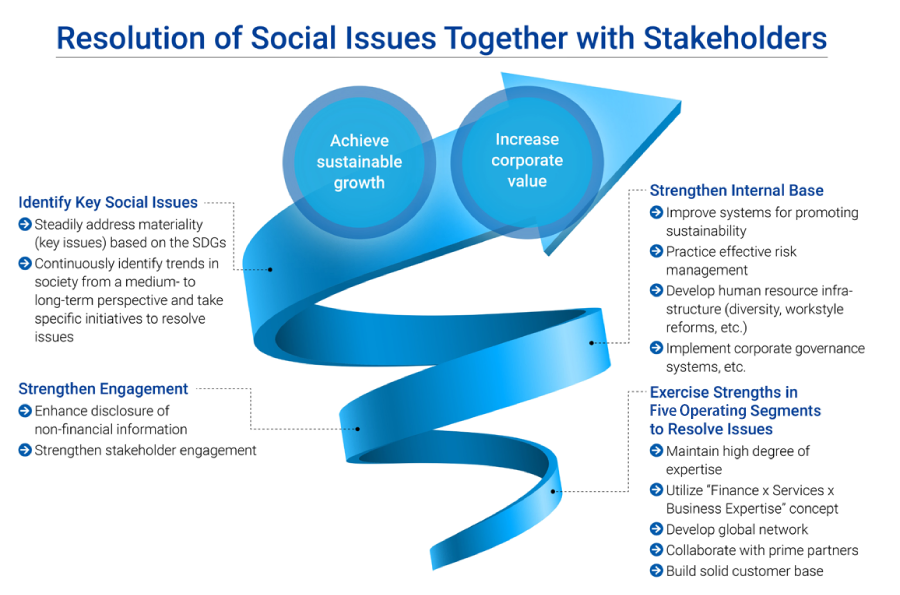
Tokyo Century’s commitment to sustainability is driven by its pursuit of further sustainable development and higher corporate value along with stakeholders as a financial services company, and it thereby contributes to the creation of an environmentally sound, sustainable economy and society. In promoting sustainability management, we envision, with due consideration of the United Nations Sustainable Development Goals (SDGs), a society 10 to 20 years into the future and then take a backcasting approach toward creating financial services that will meet the needs of that time.
Sustainability Management Promotion System
In its pursuit of sustainable growth through sustainability management, Tokyo Century has instituted a monitoring system to confirm the progress of management strategies based on the five key issues identified through our materiality assessment and to provide advice for improvements. Moreover, appropriate governance is practiced and a PDCA (plan–do–check–act) cycle is implemented to improve the effectiveness of sustainability management.
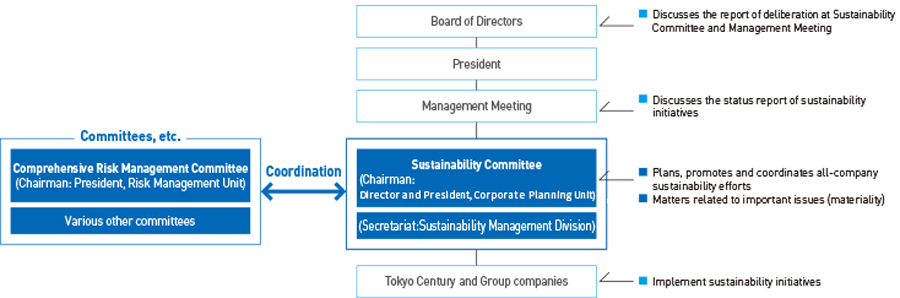
CEO : Chief Executive Officer
CSO : Chief Strategy Officer
CRO : Chief Risk Officer
CAE : Chief Audit Executive
Role of the Sustainability Committee
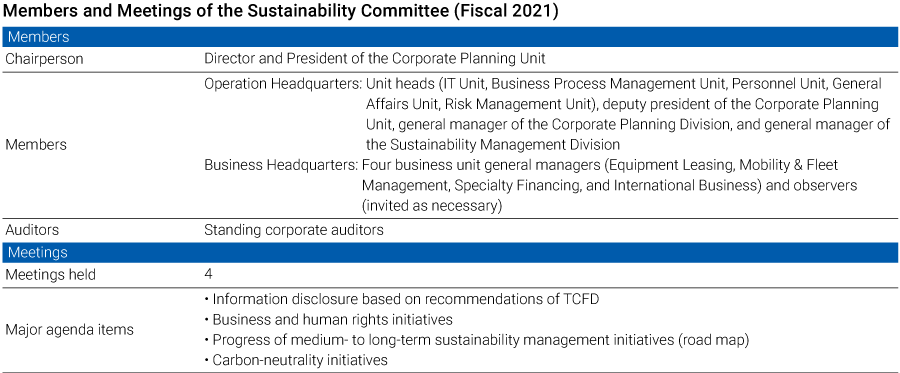
Established in April 2018, the Sustainability Committee serves as a deliberative body for sustainability management and generally meets twice a year. Critical matters deliberated by the committee are reported to and discussed by the Management Meeting and the Board of Directors, thereby establishing a system of board oversight. Chaired by the Co-Chief Strategy Officer, the committee recognizes sustainability as a key management priority and advances various initiatives, including addressing materiality items.
In addition, as an independent organization led by the Chief Audit Executive (CAE) reporting directly to the President, the Audit Division conducts internal audits (including those on sustainability matters) for Tokyo Century and its Group companies. Standing Corporate Auditors hold monthly meetings with the CAE to exchange information, and significant insights from these discussions are reported to Outside Corporate Auditors at the Audit & Supervisory Board meetings.
The Sustainability Committee collaborates with the Risk Management Committee. Risks related to climate change, personnel and labor management, human rights, and the workplace environment are categorized under operational risk, a non-financial risk category. Tokyo Century has established a framework to monitor them as non-financial risk indicators and report the results to the Management Meeting through the Risk Management Committee twice a year.
For more information on Tokyo Century’s materiality (key issues) for achieving sustainability management, please click here.
Management Philosophy Structure
For details on the Management Philosophy Structure, please click below:
Corporate Code of Conduct
The Tokyo Century Group acts in accordance with the following principles:
1. Deepening Stakeholder Relationships and Creating New Value
We contribute to business development through co-creation with our customers and all other stakeholders. By continuously challenging ourselves to create new value beyond traditional frameworks, we provide precise, high-quality products and services, thereby building deep mutual trust.
2. Sound and Fair Business Activities
We conduct sound and fair business activities in accordance with domestic and international laws, regulations, and rules, while respecting the cultures and customs of all countries and regions where we operate, thereby establishing public trust as our solid foundation. We maintain a strict stance against anti-social forces that disrupt social order and safety, as well as domestic or international criminal organizations that impede legitimate economic activities, and reject any and all relationships with them.
3. Corporate Social Responsibility and Addressing Social Issues
As a good corporate citizen, we fulfill our social responsibilities through honest and sincere business operations, while responding to society's expectations in the spirit of co-creation. We strive to take bold initiatives to drive solutions to global social issues through our business activities.
4. Respect for Human Rights and Fostering a Safe, Positive Work Environment and Corporate Culture
We respect the human rights of all individuals and actively promote diversity. We maintain a zero-tolerance policy against harassment, creating a psychologically safe work environment where everyone can work in good physical and mental health. Through these efforts, we foster a corporate culture where a diverse and unique workforce can respect and trust each other and thrive together.
5. Information Management and Protection of Intellectual Property and Trade Secrets
We strictly manage personal information and customer data acquired in the course of our business to prevent unauthorized disclosure outside the company or misuse. Concurrently, we properly protect and utilize our intellectual property and trade secrets, while respecting the rights of others.
6. Environmental Conservation and Creating a Circular Society
We strive to conserve the environment across all areas of our business activities, aiming to create a sustainable and circular society in harmony with nature.