
Health and Productivity Management
- Basic Policy on Health and Productivity Management
- Health and Productivity Management Initiatives
- Health and Productivity Management Structure
- Health and Productivity Management Strategy Map
Basic Policy on Health and Productivity Management
Tokyo Century’s Management Philosophy Structure comprises our Purpose, "Shaping Our Blue Planet," our Vision, "To Be a Company Driving Solutions to Global Social Issues with an Entrepreneurial Spirit," and our Values, "Passion," "Innovation," and "Integrity." To create new value under this framework, it is essential to develop an environment in which all of our human resources—our greatest assets—can work safely, securely, and vigorously in good health, both physically and mentally, and fully demonstrate their individuality and capabilities. To this end, we strive to maintain and improve the well-being of all our people and their families, recognizing health management as a key corporate priority. We also support the sound development of the entire supply chain, including our customers and partner companies.
1. Fostering Health Awareness
We will provide information on mental and physical well-being and support the proactive efforts of each of our people to cultivate a health-centric mindset.
2. Identifying Health Issues
We will strive to proactively identify and understand health issues based on the results of annual health checkups, stress assessments, and questionnaires.
3. Health Management and Measures
We will take active measures to address health issues and ensure the proper management of health-related information.
4. Supporting the Balance Between Work and Medical Treatment
We will promote initiatives for the early detection and prevention of illness, while supporting a sound balance between work and medical treatment.
Health and Productivity Management Initiatives
1. Fostering health awareness
- (1)Collaborate with health insurance associations to help form sound habits by providing applications that encourage healthy activities.
- (2)Work with industrial physicians and occupational health nurses to continue to provide information through e-learning and other means with the aim of raising health awareness.
- (3)Introduce the details of the health and productivity management initiatives to affiliated companies and promote mutual information sharing.
- (4)Disseminate information on our initiatives both internally and externally through our corporate website.
2. Identifying health issues
- (1)Conduct regular physical checkups, aiming for 100% participation.
- (2)Implement stress checks, aiming for 100% participation.
- (3)Disclose the results of regular physical checkups and stress checks both internally and externally.
3. Health management and measures
- (1)Provide specific health guidance to officers and employees diagnosed with metabolic syndrome as a result of regular physical checkups. Aim to have 80% or more of them receive the guidance so that they can improve their dietary and other lifestyle habits.
- (2)Provide opportunities to see industrial physicians for employees who have been diagnosed with a high level of stress as a result of stress checks, and also recommend the use of external consultation services.
- (3)Publicize health consultation services provided by the Personnel Division, industrial physicians, occupational health nurses, health insurance associations, other health organizations so that employees can relieve their mental and physical health concerns or clear up related questions.
- (4)Properly manage the working hours of all employees to prevent long working hours.
- (5)Recommend that employees telework, stagger their work hours, or take hourly leave to prevent the spread of infectious diseases.
- (6)Address women’s health issues by providing seminars and subsidizing the cost of gynecological cancer screening tests.
- (7)Implement measures to improve dietary habits and support smoking cessation.
- (8)Subsidize the cost of medical examinations for officers and employees identified as needing a re-examination or more thorough examination as a result of regular physical checkups.
4. Supporting the balance between work and treatment of disease
- (1)Recommend that employees telework, stagger their work hours, or take hourly leave so that they can continue to work while receiving treatment for disease.
- (2)Provide support for employees on mental health leave through a return-to-work support system so that they can return to work smoothly.
- (3)Provide financial support through an orphans’ pension program for education of the children of employees in the event of their death or severe disability.
- (4)Recommend and subsidize voluntary medical screening such as complete medical checkups and cancer exams to detect and treat diseases at an early stage.
- (5)Provide the special reserve leave system to support the employees undergoing infertility treatment so that they can continue to work insofar as possible.
Health and Productivity Management Structure
To continuously and effectively drive health and productivity management aligned with our corporate strategy, we have established a framework led by the President and CEO.
Under the oversight of the Chief Human Resources Officer (CHRO), we systematically manage all stages of our initiatives—from planning and implementation to impact evaluation—in close collaboration with the Employees' Union, the Occupational Health and Safety Committee, the Health Insurance Association, and occupational physicians and health nurses.
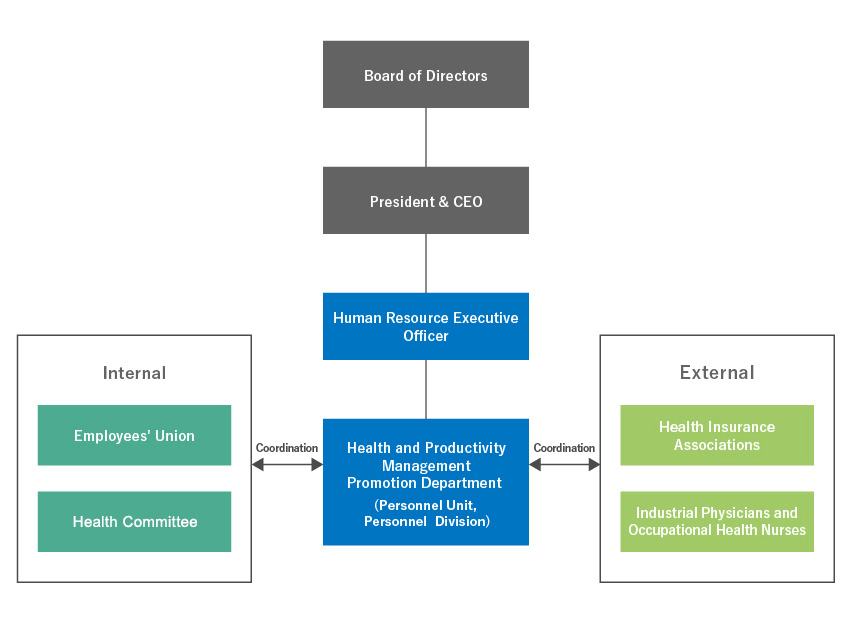
CEO : Chief Executive Officer
CHRO : Chief Human Resources Officer
Health and Productivity Management Strategy Map
The health and well-being of our people—our greatest asset—is the key driver in realizing our Purpose, "Shaping Our Blue Planet."
This Health and Productivity Management Strategy Map shows the connection between our investments in health (initiatives) and their outcomes. It outlines a roadmap to drive mindset and behavioral shifts among all officers and employees through these efforts, aiming to enhance job satisfaction, employee engagement, and human capital, and thereby solve corporate challenges.
We will continue to focus on creating a safe and secure workplace where all our people can thrive and take on new challenges.

- *As of August 2026
- *Please refer to the "Sustainability Data Book" for target figures and historical performance.
Health-Related Data
Our Health and Productivity Management Strategy Map positions reducing presenteeism*1, reducing absenteeism*2, and enhancing work engagement as key outcome indicators.
We also consistently maintain high participation rates for regular health checkups and stress check surveys. By continuously tracking this data and analyzing employee health and workplace environments, we refine and improve our initiatives.
Scrollable horizontally
| FY2023 | FY2024 | FY2025 | ||
|---|---|---|---|---|
| Regular Health Checkup Rate | 100% | 100% | 100% | |
| Stress Check Rate | 100% | 100% | 100% | |
| Presenteeism (Productivity Index)*3 | 86% | 85% | 85% | |
| Absenteeism*4 | 2.2 days | 2.2 days | 2.0 days | |
| Engagement Index*5 | Philosophy Integration + Cultural Reform + Policy & System Enhancement*6 |  |
3.2 | 3.3 |
| Overall Engagement Score*7 | 53.2 | 56.2 | 57.1 | |
| Rating | BB | BBB | BBB | |
- *1A state where health issues prevent employees from performing at their full potential despite being at work.
- *2Absence from work due to health issues.
- *3An indicator measuring the percentage of potential performance maintained after accounting for health-related productivity losses. Higher values indicate better performance. The index is measured using a productivity index related to work performance, quality, and quantity, based on Humanage, Inc.'s database. (FY2025: 1,306 employees surveyed, 100% response rate)
- *4The average number of days taken off due to personal illness during the past year, based on survey responses. (FY2025: 1,306 employees surveyed, 100% response rate)
- *5Measured via Link and Motivation Inc.’s Motivation Cloud. (FY2025: 1,328 employees surveyed, 99% response rate)
- *6Maximum score is 5.0.
- *7Standardized score, with the national average set at 50.
Read our interview with Dr. Hidekazu Mori, Tokyo Century’s occupational physician, in the Tokyo Century News article, "Occupational Health Physician Tips on Health and Productivity Management—What a Company Can Do for Officers and Employees."